

By Dennis Sadowski
Artificial intelligence, or AI, has been playing an increasingly significant role in daily life. From helping explain complex business, economic and scientific concepts to serving as a vacation planning tool, AI programs seem to be inescapable. AI is establishing a presence in stamp collecting as well.
Collectors are turning to various AI tools to gain general knowledge, categorize stamps and even prepare competitive exhibits for stamp shows.
Despite its apparent helpfulness, one computer scientist connected to the stamp collecting hobby cautions that AI lacks the “collector instincts” that come from real-world examples.
“AI is a tool that amplifies expertise but does not replace it. It is an assistant, not an authority,” said Tom Droege of Durham, North Carolina, who developed and runs Stamp Auction Network, an online platform for philatelists to find, research and bid on stamps from worldwide auction firms.
“Right now for philately, the AIs are much better on more general stamp collecting knowledge,” he recently told me, citing the example of posing a question about Great Britain’s 1840 1-cent Penny Black stamp, the world’s first postage stamp. AI, he said, “can give you a pretty good start.”
However, an AI’s responses to questions about inking, postmarks, watermarks, perforations, stamp usages and mail rates fall woefully short in providing accurate and useful information because such material is not readily available through the internet, Droege said.
“AI is a tool that amplifies expertise. It does not replace it. It is an assistant, not an authority,” he said.
In January, Droege led an online seminar about the use of AI in philately sponsored by the British Empire Study Group, an organization dedicated to the study of the philately of Great Britain and its colonies. He urged participants to become familiar with how AI works lest they be left behind in a quickly evolving world.
Droege described an AI as a large language model computer program that works through “pattern recognition, not conscience recognition.” It takes data points in answering a question and “predictively word by word creates a response where it statistically thinks the words written so far give an answer.”
“But it’s not really intelligent,” he said.
An AI can, for example, help a person develop a presentation of a specified length on a given topic and include the key points the presenter wants to cover. While the result will be something the user can present, it may result in a text that does not include human nuances in speech or personality.
Building from Droege’s example, I asked one AI program (which shall go unnamed) to prepare a 600-word column about using AI in stamp collecting. The result was disappointing, rather uninspiring and, I’ll say, dry and technical. It certainly did not read like anything I would write, although it did include a paragraph cautioning that “AI in stamp collecting is as a partner, not a substitute.”
Perhaps more precise guidance would have generated something worth reading. That, too, Droege said, is key to using AI: being specific in what is being sought.
Droege called on the philatelic community to come together to develop online information in order for AI to be an eminently useful tool for stamp collectors. In particular, he suggested that specialty societies, expert exhibitors and collectors, stamp dealers and auction firms set guidelines on providing the detailed information collectors need in various online platforms so that AI can pull that data when a request for specific information is posed.
“We need to build those resources for the future so they can be curated and we can get better responses. Collectors must control the data, create their own AI agent for philately. We create it so it is using philatelic literature we’ve provided. That’s how it’s going to get accurate responses,” he said.
“We can’t operate in these little territories. For the sake of our hobby, we need to work together to store this information for future collectors. We have the tools to do it.”
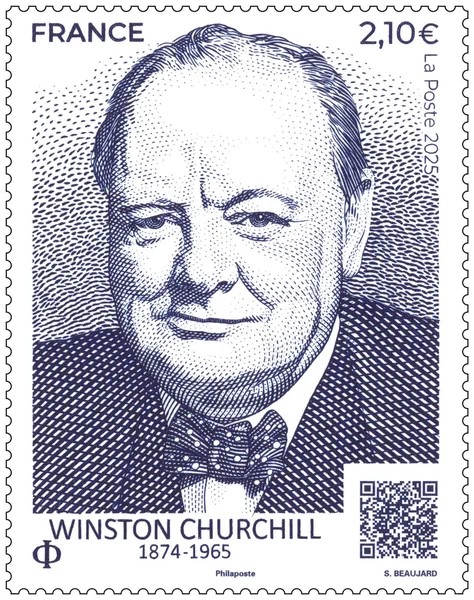
La Poste, France’s postal agency, in October unveiled the first “talking” stamp. Calling it a conversational AI stamp, users can scan a QR code in its design to begin an interactive conversation about Winston Churchill with an AI.
Sadowski can be reached at sadowski.dennis@gmail.com