

By Dennis Sadowski
Just about 110 years ago, the Yellow Dog flew mail along the Rhein and Main rivers in Germany to raise money for charity.
Known as Gelber Hund in German, the Yellow Dog was a biplane that carried mail along the vital waterways, supplementing the regular mail service provided by the airship Schwaben.
German engineers and inventors pioneered the use of airships, known as zeppelins or what we call blimps today, for transportation. The use of zeppelins evolved so that during World War I they took part in strategic bombing, long-range reconnaissance, and naval patrolling. But in 1912 zeppelins served a more sublime purpose.
The Gelber Hund demonstration flights lasted from June 10 through June 22, 1912, initiated by Grand Duke Ernest Ludwig and Grand Duchess Eleanore of Hesse, who sought to raise funds for the Grand Ducal Head Office for Mother and Infant Welfare in Hesse, Germany.
It should be noted that much of the flown mail was generated by collectors. Nevertheless, such souvenirs are highly sought by aeronautical postal historians. Such covers exist from a time when airflight was still young and people were excited to receive a piece of mail that actually flew overhead rather than travel by carriage or primitive motorized vehicle.
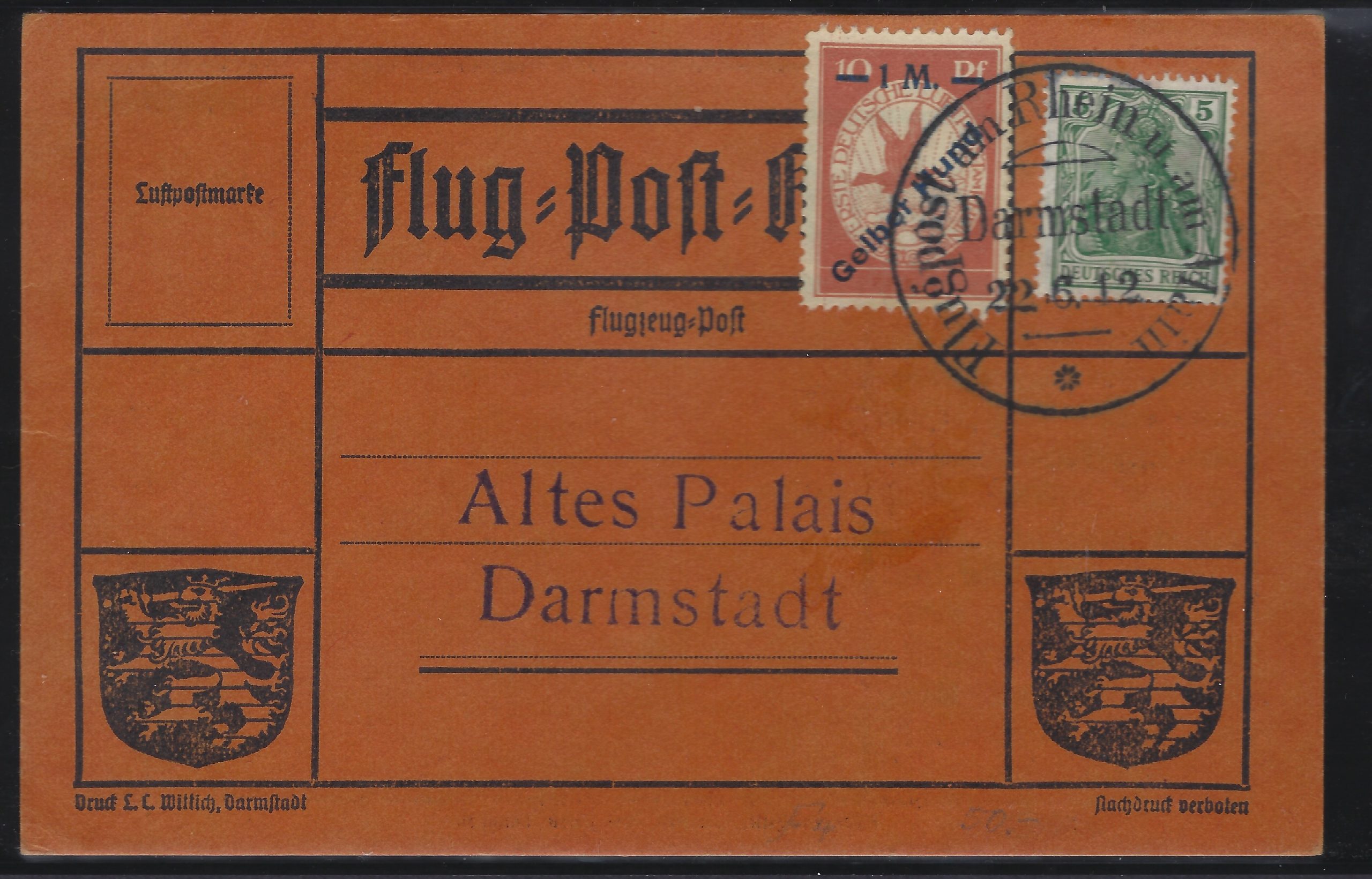
The orange souvenir postcard shown is typical of the mail on the Gelber Hund flights. It is franked with a 5-pfennig Germania stamp paying the inland postcard rate. A second semi-official 10-pfennig airmail stamp was used as well. It is surcharged in blue with a higher rate of “1 M” (1 mark) and “Gelber Hund,” raising the funds for the charity.
Both stamps were canceled on June 22, 1912, in Darmstadt, Germany, one of the stops on the route, with the special “Flugpost am Rhein u. am Main” (Airmail on the Rhein and the Main) postmark. It is addressed to the Altes Palais, a neoclassical palace in Darmstadt that at one time served as the city residence of the Landgraves (count) of Hesse-Darmstadt.
History tells us that the Landgraviate of Hesse-Darmstadt was a sovereign state in the Holy Roman Empire, established in 1567 following the partition of Hesse after Landgrave Philip I’s death. Under the House of Hesse, it became a prominent Lutheran territory with Darmstadt as its capital. The region became a grand duchy in 1806, a result of the Napoleonic Wars, and lasted until the end of World War I in 1918.
The first flight of the Gelber Hund took place on June 10 when pilot Ferdinand von Hiddessen took off from Frankfurt-Niederrad with about 88 pounds of mail, heading to Darmstadt. The plane’s name is taken from the yellow color of its wings.
Other stops on the route were Worms and Mainz.
Despite the publicity surrounding the mail service, the Gelber Hund made only six flights with stops for a day or more in between. A total of 460,700 pieces of mail were flown. The largest amount came from Darmstadt, with 193,035 pieces bearing the town’s postmark.
The Schwaben also carried mail on the days the Gelber Hund flew. Mail carried on the biplane is not marked to distinguish it from that which flew on the zeppelin. Still, an owner of a Gelber Hund cover can dream that it was actually among those flown on a small plane to raise money for a worthwhile charity during a short period 110 years ago.
Dennis Sadowski can be reached at sadowski.dennis@gmail.com.