


By Dennis Sadowski
In case you didn’t know it, December is Cat Lovers Month.
From cat videos to smarmy slogans about how cats are superior to dogs (long held as man’s best friend, by the way), humans have shown their affection for felines.
Established in the mid-1990s, Cat Lovers Month helps raise awareness about the needs and well-being of cats as pets. The month also encourages cat adoption, emphasizes responsible care and population management, and shares the message of the joy and companionship cats provide.
Cats have long been depicted on stamps around the world. Before we look at some of the stamps issued over the decades, let’s explore a few cat facts compiled by Alley Cat Allies, which promotes cat welfare.
Indoor cats: For more than 10,000 years cats lived outdoors and were part of the wildlife humans naturally encountered. Even into the 20th century few cats lived entirely indoors. Of course, millions of cats live outdoors today. Most domestic cats probably would survive outdoors if they had to.
Relationship with humans: History shows that cats began a “unique relationship” with humans about 10,000 to 12,000 years ago. It was in the Fertile Crescent, a region encompassing modern-day Lebanon, Israel, Jordan, Palestine, Syria and parts of Kuwait, Turkey and Iran, that cat-human interaction evolved.
As humans ended their nomadic ways and established settlements, leading to the need to grow food, stored grains attracted rodents, providing the scavenging Middle Eastern wildcats (felix silvestris lybica) a steady source of food. Over the centuries the domestic cat (felis catus) evolved from that earlier species.
Cats historically: Ancient Egyptians worshipped, mummied and sometimes even dressed cats in golden jewelry, showing their owners’ status. After Egypt became a province of the Roman Empire in 31 BC, cats were introduced to the Romans. By 500 AD cats were widespread in Europe. They found their way on ships to North America and reportedly they tagged along with Christopher Columbus and the Pilgrims on the Mayflower.
With such a long history, it’s no wonder that since the mid-20th century cats on stamps—domestic, wild or heraldic—are a popular topic with dozens of stamps issued around the world.
There’s even an organization of dedicated to this philatelic genre. The Cats on Stamps Study Unit of the American Topical Association has been around since 1979 and publishes an award-winning journal called “Cat Mews.” For more information visit online at www.catstamps.info/home.html.
Cat stamps around the world
Now for a few stamp issues.
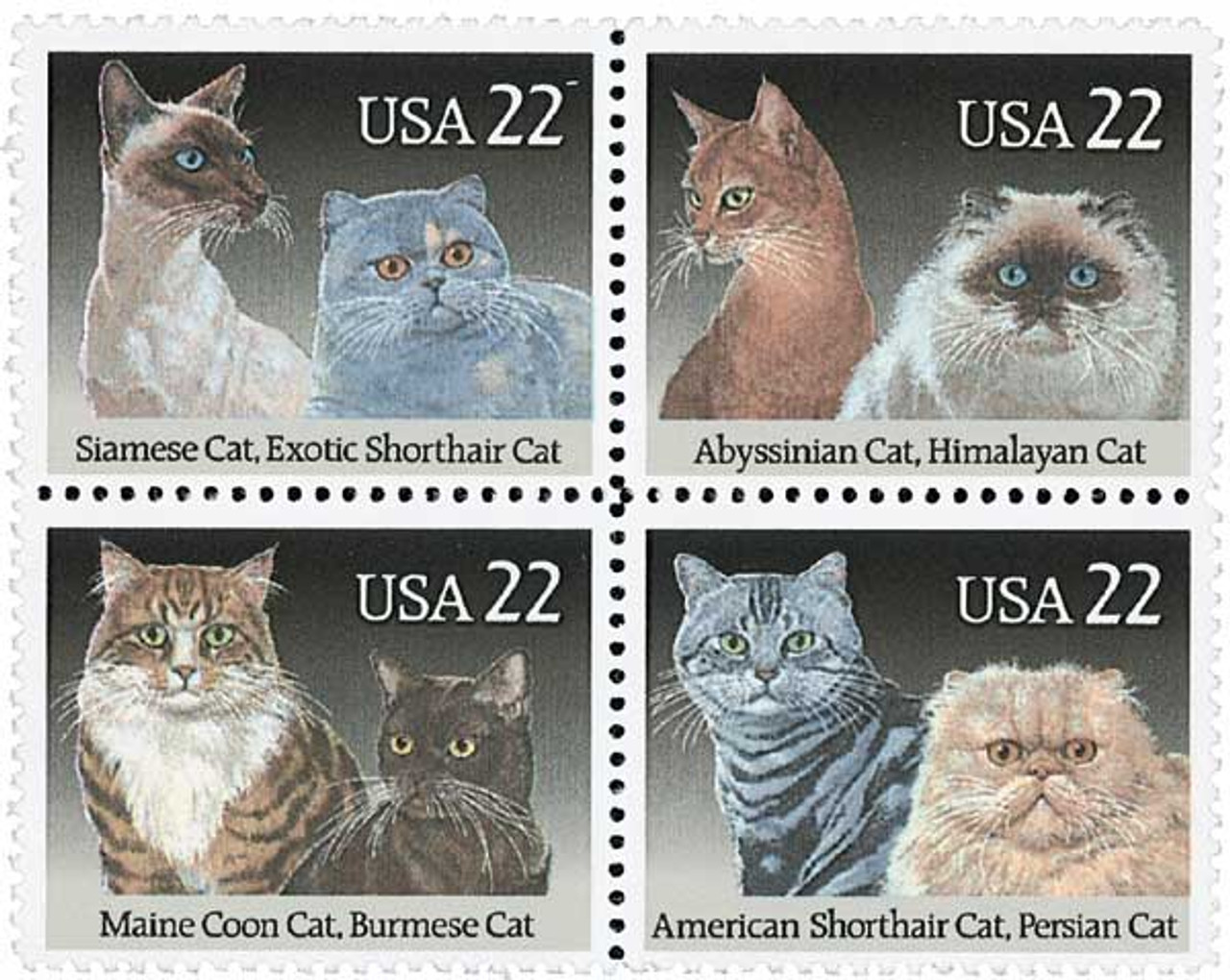
In the United States, a block of four 22-cent stamps from 1987 depicts eight cat breeds: Siamese, exotic short hair, Abyssinian, Himalayan, Maine coon, Burmese, American shorthair and Persian.
Ten 44-cent stamps promoting animal rescue in 2010 showed five cats along with five dogs. Most recently, in 2016, a set of 20 “forever” stamps highlighting pets included one cat stamp among a plethora of animals.
It seems like it may be about time for more cat stamps from the U.S.
Poland joined the cat parade in 1964 with a set of 10 stamps in values ranging from 30 groszy to 3.40 złoty. The stamps show cats in various poses including a cute yawning kitten.
An attractive pane of six stamps from Poczta Polska, the Polish postal service, issued in 2010 features a half-dozen breeds of domestic cats with values of 1.55, 1.95 and 3 złoty.
The West Africa nation of Sierra Leone has capitalized on the popularity of cat topicals with numerous stamps over the years including 24 issued in 1993. The stamps are arranged in two panes of a dozen 150-leon stamps and picture popular global cat breeds such as Egyptian Mau smoke, Mi-Ke Japanese bobtail, British calico shorthair and Norwegian forest.
While colorful, such large stamp issues usually target the international market and help boost revenue for countries struggling to provide basic services.
A collection of cat-themed stamps can span the world and include pictorial postmarks and mail from cat owner societies. Among other countries that have issued cat-themed stamps are Australia, Cambodia, Cuba, Great Britain, Hungary, Pitcairn Islands and Togo.
Sadowski can be reached at sadowski.dennis@gmail.com