

By Dennis Sadowski
There’s a day to celebrate just about anything it seems, even stickers.
Jan. 13 marks National Sticker Day, established 10 years ago by StickerGiant, an online company that produces stickers for a variety of purposes.
What’s that got to do with stamp collecting, you wonder? In a way, stamps are a kind of sticker that prepays postage on letters and packages. Just don’t tell collectors, especially those at the high end of the hobby, that their albums hold a bunch of stamp stickers regardless of their historic or monetary value.
Stickers today, like stamps, are produced with pressure-sensitive gum, allowing them to be peeled from a backing paper and easily placed on just about anything to communicate an idea, political message, emotion, product or greeting.
R. Stanton Avery developed pressure sensitive, or self-adhesive, technology in 1935. He was born on Jan. 13, 1907, and National Sticker Day marks his birthday. Avery, founder of what today is the Avery Dennison Corp. died Dec. 12, 1997.
Historical note
After his invention, Avery established the Kum-Kleen Adhesive Products Co. later Avery Adhesives and still later Avery International. In 1990 the company purchased the Dennison Manufacturing Co. which produced paper products. Dennison also produced a type of stamp hinge for mounting stamps that remains highly sought after by collectors today because they featured gum that allowed a hinge to easily be peeled from a stamp. The hinge style no longer is produced.
At their start in the 19th century, stickers, labels and stamps would have a gum paste applied to their backside. The gum would be dried before packaging and shipping. When moistened, usually by someone’s tongue and occasionally by brush, a stamp or sticker could be applied for its intended purpose. Call it lick and stick. Hence the term “stickers.”
It took about three decades before Avery’s technological breakthrough would make its way to stamps. The first self-adhesive stamps were released in the mid-1960s by countries in tropical climates, such as Sierra Leone and Tonga, which wanted to avoid the tendency for stamps to stick together in humid conditions.
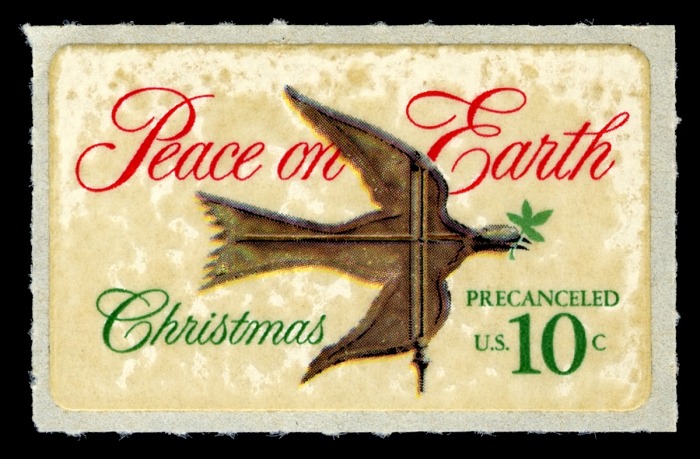
The first pressure-sensitive stamp issued by the U.S. Postal Service appeared in 1974 with the goal of convenience for users. Produced by Avery Dennison, it featured a dove weathervane and was issued for the Christmas mailing season. It was imprinted with the word “PRECANCELED” so it did not have to pass through a postmarking machine.
The stamp also was produced with slits so it could not be soaked or pulled off of an envelope for reuse.
However, the stamp turned out to be a failure of sorts. Collectors, accustomed to soaking stamps from paper in a water bath before placing them in an album, could not get the stamps to release from paper no matter how hard they tried. The instability of the gum on the back also caused discoloring in the stamps—both mint and used—before long.
Avery Dennison went back to work to perfect its product. It was 15 years before the next self-adhesive stamp was issued by the USPS a 25-cent design featuring a patriotic theme with a bald eagle and shield. It was produced in a pane of 18 stamps and made available in select cities.

By 1989 self-adhesive stamp technology improved, leading to the release of a pane of
18 stamps featuring a bald eagle and shield in a denomination of 25 cents. Today
virtually all stamps are produced with self-adhesive gum, just like stickers.
In 1990 self-adhesive stamps in panes of 12 appeared in the size of a dollar bill so they could be dispensed from bank ATMs. Gradually more and more self-adhesive stamps were produced each year and by 2002 virtually every stamp released—except for a few meant to mimic classic issues and aimed at collectors—is the pressure-sensitive variety, much to the pleasure of postal users.
Some collectors still dislike them because used copies are best saved by clipping from an envelope and saved without removal from the backing paper.
Globally, self-adhesive stamps are not nearly as prominent, with most postal agencies supplying traditional lick-and-stick adhesives among their offerings.
Club meeting
The Black River Stamp Club hosts its first meeting Wednesday at the North Ridgeville Branch of the Lorain Public Library, 35700 Bainbridge Road. Doors open at 5 p.m. with a time for socializing. A short business meeting will be followed by the club’s regular monthly auction. Anyone with an interest in stamps and postal history is welcome.
Sadowski can be reached at sadowsk.dennis@gmail.com.