

By Dennis Sadowski
With the launch window for NASA’s Artemis II mission opening on Feb. 6, excitement is building for humanity’s return to the moon. The crew of Reid Wiseman, commander, Victor Glover, Christina Koch and Jeremy Hansen will be the first humans to venture to the moon in a flyby mission since Apollo 17 left Earth’s satellite in December 1972.
There will be other launch windows roughly a month apart in March and April and one of those periods may be more realistic for the start of the long-delayed 30-day mission given the testing of the Space Launch System and Orion spacecraft since its Jan. 17 rollout to the launch pad.
Astrophilatelists, those who collect space-themed stamps and covers, are as excited as anyone. The field can include mail postmarked on launch dates of crewed missions, satellites and interplanetary flights; splashdowns; rocket and spacecraft tests; balloon flights; high-speed and high-altitude plane testing; and participating tracking stations, facilities, ships and supporting aircraft.
Charles Vukotich of Pittsburgh, author of the Exploring Astrophilately column for Linns Stamp News, is among those anticipating the upcoming Artemis launch.
“Astrophilately is coming back,” said Vukotich, who has collected and created space-themed covers since he was a teenager in 1964. “I’m seeing there are people now getting interested in astrophilately because we’re going back to the moon and talking about Mars. There was a big bump in interest in the 50th anniversary of the Apollo 11 moon landing (in 2019). I’ve seen a surge in interest.”
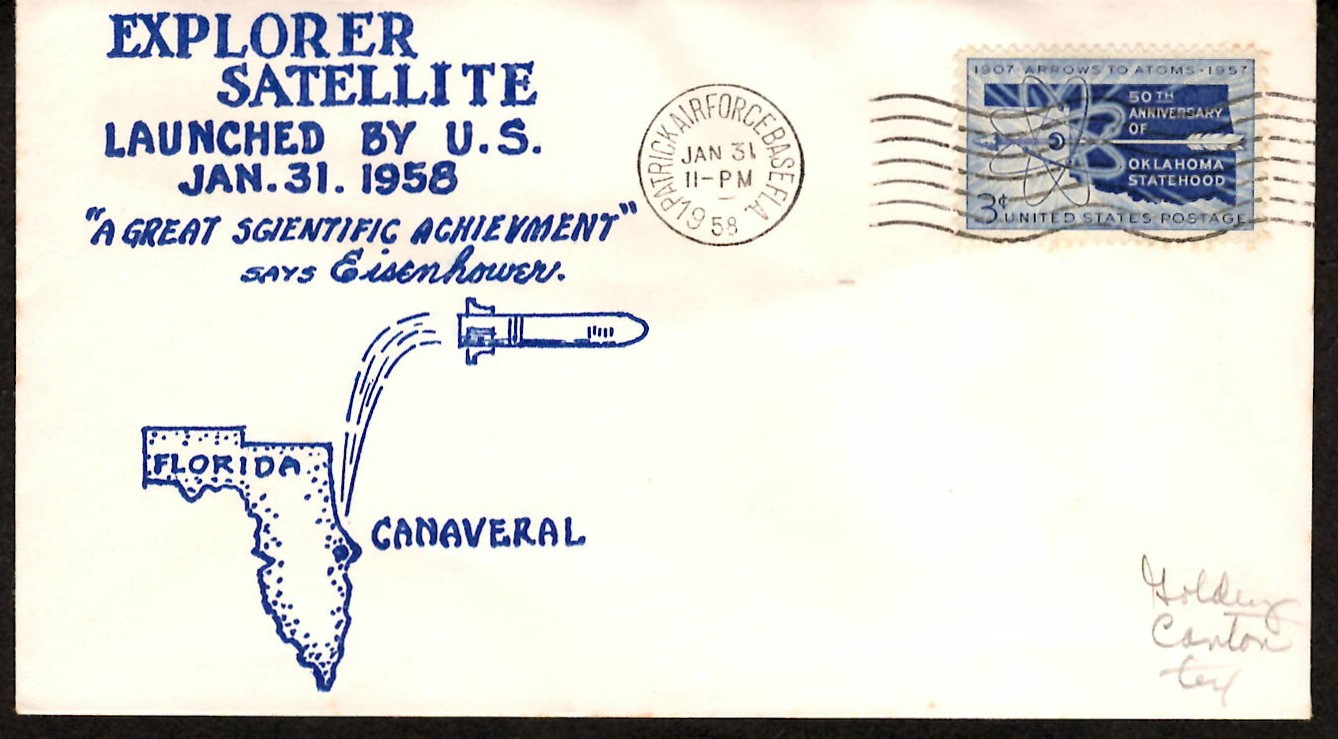
Commemorative covers for the Jan. 31, 1958, launch of Explorer 1, the first American satellite, are among the most popular collectible items. Earlier covers marking rockets tests and research breakthroughs are rare and are considered part of the astrophilately field.
The Soviet Union launched the first satellite on Oct. 4, 1967. Material related to that mission is difficult to find and collectors should be aware that fake items exist.
Vukotich said collectors have arranged to have covers for various launches since the 1960s postmarked at Florida post offices near Cape Canaveral, NASA’s primary launch site, including Patrick Air Force Base, Port Canaveral and even the Kennedy Space Center before that post office closed. Now many covers are postmarked in Titusville, the post office closest to KSC.
Stamps commemorating individual astronauts, space missions, interplanetary spacecraft and astronomical discoveries are plentiful from postal administrations around the world. The Soviet bloc in the 1960s and 1970s in particular issued myriad stamps as propaganda to highlight its technical prowess over the West.
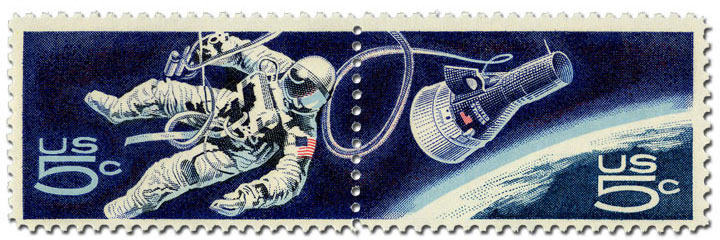
A se-tenant pair of stamps marking the first space “walk” of an American astronaut was
issued in 1967. The stamps, known as the Space Twins, pictures astronaut Ed White
outside of the Gemini 4 mission on June 4, 1965.
By comparison, European nations and the U.S. limited their space-themed stamps to those that highlighted the most accomplished feats such as the 1969 Apollo 11 mission, the first to land humans on the moon, the 1965 space “walk” of Astronaut Ed White aboard Gemini 4 and space probes throughout the solar system.
The Space Topic Study Unit of the American Topical Association is home to astrophilatelists, but membership has waned since its heyday a half-century ago. Vukotich said he believes the seeming growth of interest in space-themed stamps and mail may help boost the unit again.
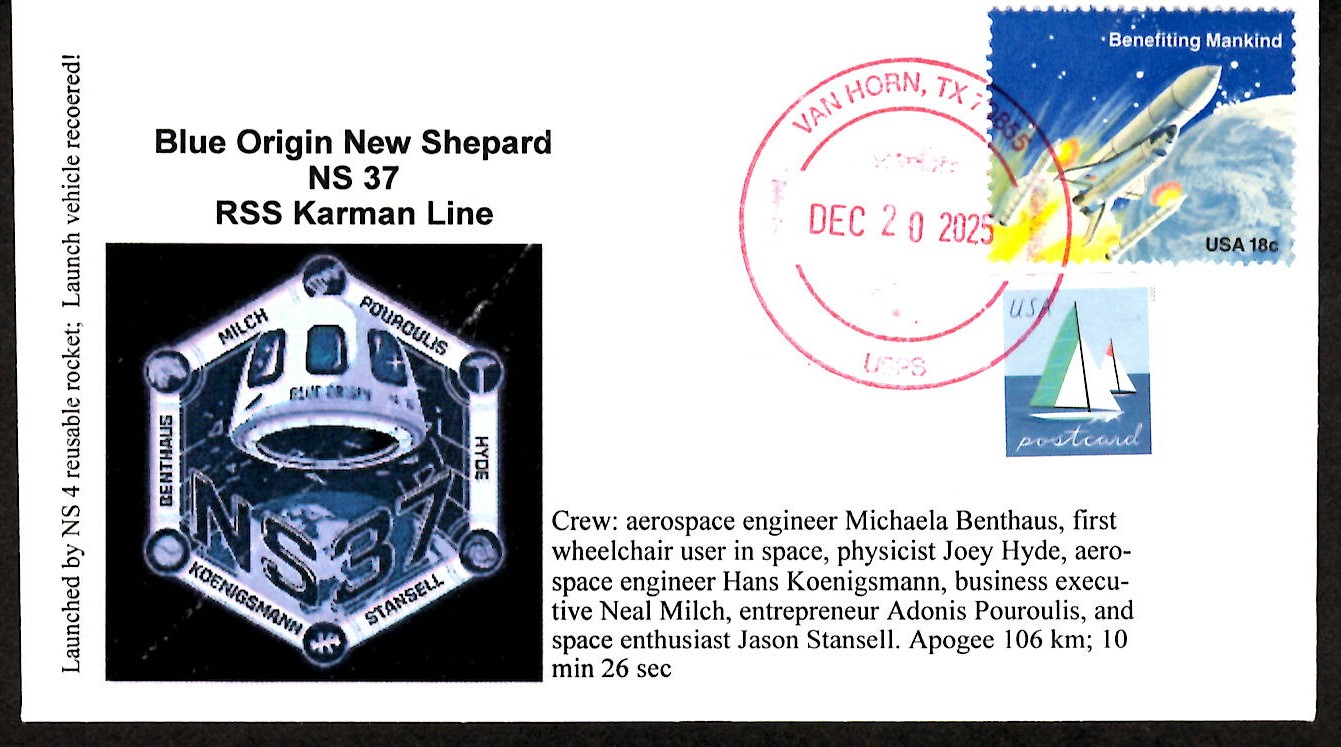
Blue Origin has been sending people on suborbital rides from West Texas since July
2021. A cover from the most recent flight on Dec. 20 launched from near Van Horn,
Texas, includes a cachet designed by space collector Chuck Vukotich that shows the
crew patch. The suborbital flight, which lasted about 10 minutes, carried the first person
using a wheelchair to fly into space.
Astrophilately is expanding quickly especially as private companies such as Blue Origin have entered the space business, Vukotich said. At times, the private companies will offer to carry postmarked mail to the edge of space on test flights and celebrity missions.
Covers marking launches in China, where astrophilately is “very popular,” Russia, India and Japan as well as European Space Agency missions in Guyana exist, but some can be difficult to find in the market, Vukotich explained.

Individuals can obtain a souvenir boarding pass for the planned upcoming Artmemis II
moon flyby mission and register to have their name digitally taken aboard the Orion
spacecraft on its 10-day mission.
Want to join the Artemis mission? Register at www.nasa.gov/nasa-virtual-guest-program to get a digital boarding pass for the flight and to send your name with the astronauts to the moon digitally.
Sadowski can be reached at sadowsk.dennis@gmail.com.