

By Dennis Sadowski
For centuries potato growing never was an easy endeavor for farmers. Imagine even 150 years ago the exhaustive back-breaking work of digging potatoes from the ground and then collecting the spuds for market.
During the harsh winter of 1884-1885, Erie County farmer Isaac Hoover sought to change how potatoes were harvested, leading to a revolution for potato growers across the country.
Working in his workshop and using knowledge and experienced gained from years of potato farming, Hoover invented and patented the Hoover Potato Digger on his farm in Avery in Milan Township.
The device was designed to be pulled by horse, pushing a blade through the soil to loosen the tubers, sort them from soil and rocks and move them via conveyor for easy retrieval. The machine was powered by its wheels in a continuous process that allowed vast fields to be harvested in a day.
Until Hoover’s invention, potatoes had been harvested the same way they had since the 1620s after the root crop arrived in the American colonies: by pitchfork, hoes and spades. Workers were bent over and used their hands to feel for the starchy orbs. At the end of the day, workers often had bloodied hands, sore backs and aching knees. Debilitating injuries were common.
Families planned their lives around “potato gathering holidays” whereby all members, including children kept home from school, neighbors and hired hands joined the tedious harvest each fall.
Born in Clinton County in 1845, Hoover became one of Ohio’s most successful potato farmers by the 1880s after relocating to Erie County. Despite his success, Hoover sought a new way to harvest the crop. One potato digger could turnover enough land in a day to fill 500 bushels. Later improvements boosted the amount of soil that could be tilled.
Demand for Hoover’s innovation quickly grew. Hoover realized he couldn’t produce enough machines on his own to meet that demand. Hoover turned to his brother-in-law Albert Prout, who had experience in business and understood manufacturing, to establish the Hoover & Prout Co.
The new company produced 50 machines for local farmers in 1885. Demand grew as farmers saw how transforming a mechanized digger could be in their lives.
The development led Hoover to think of ways to market his machine to wider audiences. Hoover and Prout took their product to the 1893 Columbian Exposition. Interest in the digger skyrocketed. The company began advertising its machine in various publications and through the mail.
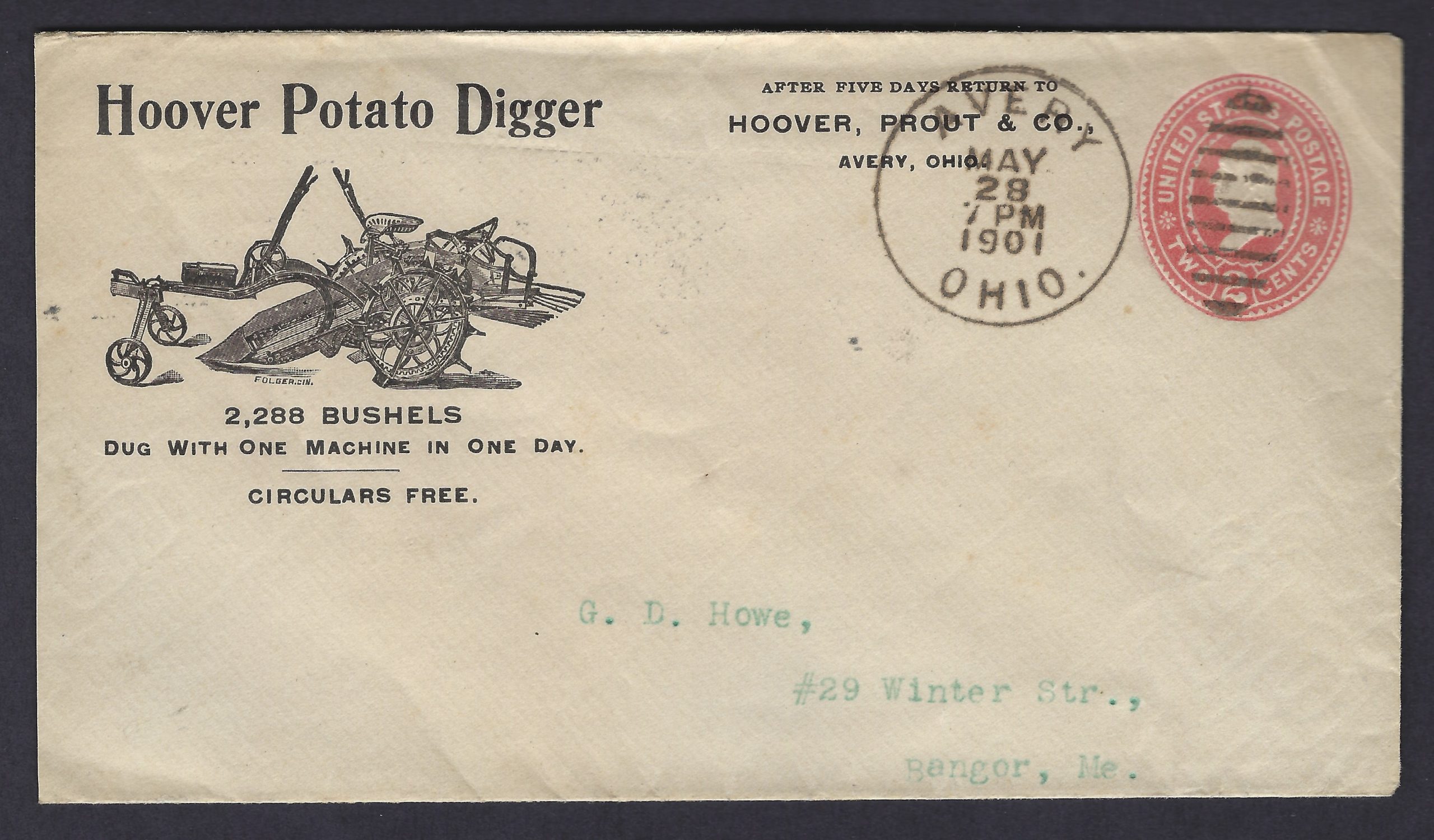
One early 20th-century mail piece shows how Hoover & Prout advertised their popular tool. A standard-size postal stationery envelope with an embossed 2-cent indicia depicting George Washington shows an image of the potato digger below the company’s name. It boasts in two lines: “2,288 BUSHELS DUG WITH ONE MACHINE IN ONE DAY.”
The mailing was postmarked in Avery on May 28, 1901, and sent to Bangor, Maine, likely to a customer or a potential customer.
Prout left the company in 1910, leaving Hoover the choice to retrench and simply meet local needs or expand into an industrial enterprise. He chose expansion, establishing the Hoover Manufacturing Co. in Avery, with 75 to 100 employees who produced 5,000 diggers annually by 1914. Other products followed, further mechanizing the potato production cycle. Soon a partnership evolved with Deere and Co. — John Deere today.
Deere eventually bought Hoover’s operation, moving production to Syracuse, New York, in 1926.
A 30-minute documentary telling the story of the Hoover Potato Digger is online on YouTube at www.youtube.com/watch?v=AK7ww9BCfUw.
Club Meeting
The location of the Black River Stamp Club’s May 13 has been changed. The club will meet for this month only at the North Ridgeville branch of the Lorain Public Library, 35700 Bainbridge Rd. Doors open at 5 p.m. Anyone with an interest in stamps or postal history is welcome.
Dennis Sadowski can be reached at sadowskidennis@gmail.com.