
By Dennis Sadowski
On a recent trip to France, we found ourselves traveling across Paris from the 13th arrondissement where we were staying to the Foundation Louis Vuitton in the city’s beautiful Bois de Boulogne to see the works of American sculptor Alexander Calder.
Yes, that Louis Vuitton. The foundation was established by the luxury goods conglomerate in 2014 with a commitment to the contemporary arts. It is hosting an exhibition of nearly 300 pieces of Calder’s spirited work.
Running through Aug. 16, “Calder. Rêver en Equilibre” (Dreaming in Equilibrium) showcases Calder’s creativity that found him working in various media over eight decades.
It includes original pieces from his childhood, jewelry for friends and family, and massive “stabiles” created until his death Nov. 11, 1976.
The exhibition marks the centennial of Calder’s arrival in Paris as a young artist (age 27) as well as the 50th anniversary of his death at age 78.
The path through the exhibit follows a mesmerizing trek to witness Calder’s playful nature. Friends and fellow artists have described him as a “grown-up child” who found joy in creating whimsical kinetic mobiles and wire figures of people and animals along with massive sculptures that grace public spaces around the world.
Prior to Calder’s entry into the art world, sculpture was static. He widened the vision of what sculpture could be by creating carefully balanced designs that moved in random patterns.
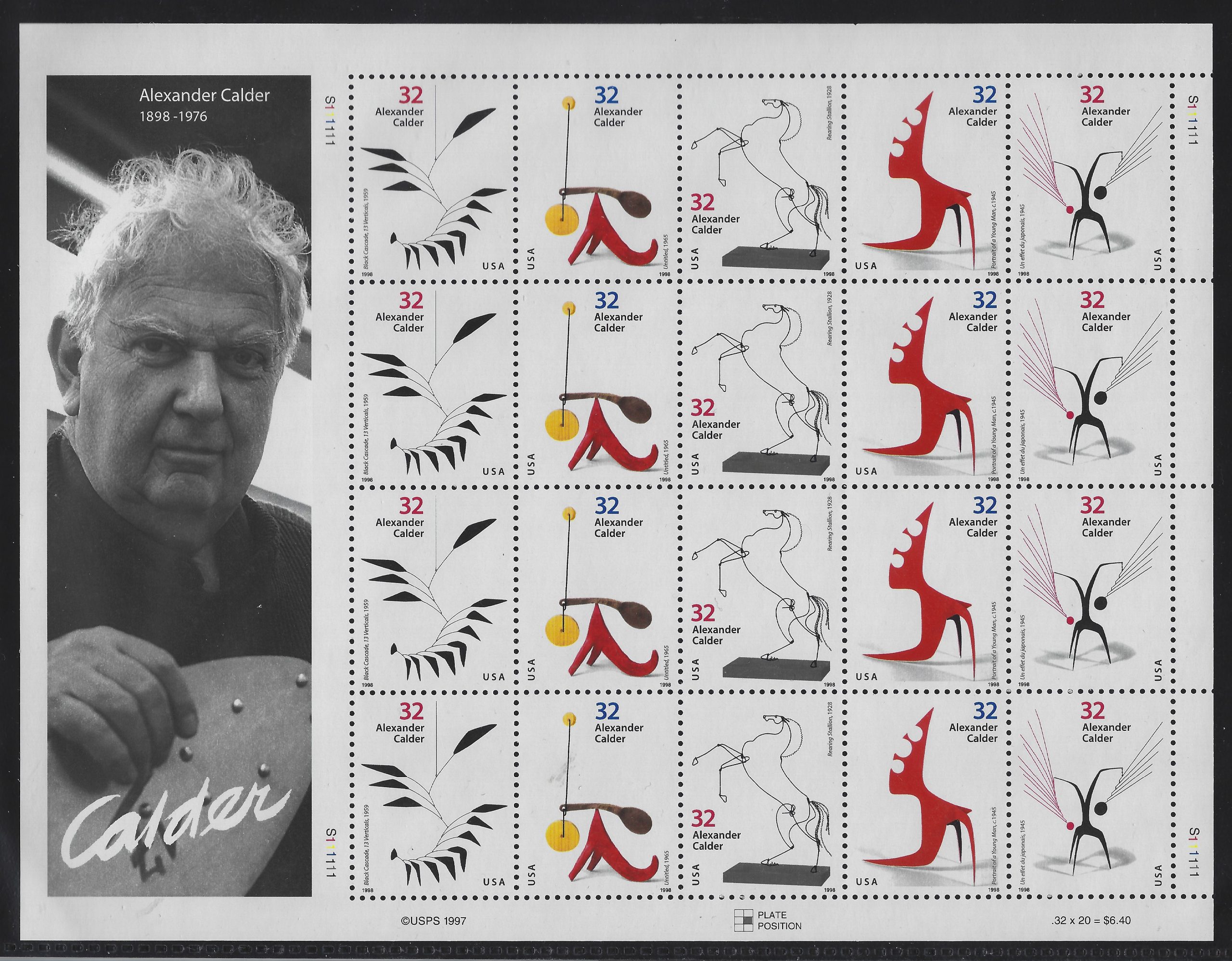
Calder and his art were honored in 1998 by the U.S. Postal Service with a pane of 20 32-cent stamps in five designs to mark the 100th anniversary of his birth. The full pane includes a portrait of the innovative artist with a sort of impish look on his face at left with his trademark “Calder” signature below.
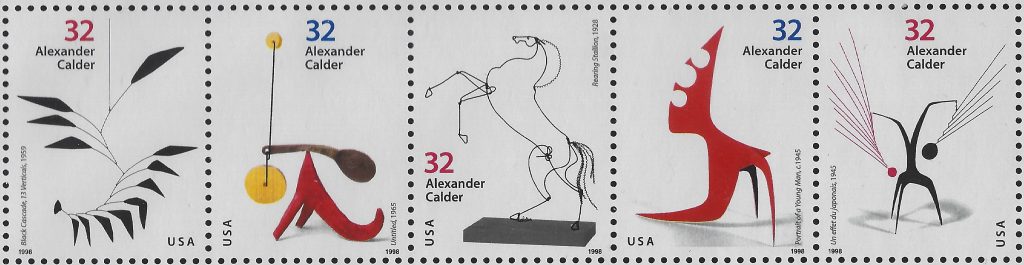
The stamps depicted, in order, are a mobile titled “Black Cascade, 13 Verticals” (1959); an untitled mobile featuring intersecting metal rods and abstract, paddle-like elements (1965); a wire “Rearing Stallion” (1928); “Portrait of a Young Man,” a 3-foot tall stabile (1945); and “Un Effet du Japonais,” an 80-inch tall moving sculpture made of sheet metal, wire, rod and paint (1941).
Calder was born July 22, 1898, in Philadelphia. His father and grandfather were well-known sculptors themselves. His mother was a painter. Art was in his bloodline.
However, as a young man, Calder initially resisted any call to the art world. He gave engineering a try, lasting only two weeks on the job. In 1922, he became a mechanic on a passenger ship. He recalled in his autobiography how, upon awakening one morning off the coast of Guatemala after sleeping on a coil of rope on deck, he was inspired by “the beginning of a fiery red sunrise on one side and the moon looking like a silver coin on the other”.
Not long after, he was back in New York, joining the city’s lively art community.
In 1926, his personal journey led him to Paris, the birthplace of modernism. At first, he created posters and illustrations to support himself. On the side, he tinkered with wire and wood—inexpensive media for a young artist.
There, he entertained audiences of all ages with a miniature circus in his apartment in which he created all of the performers and manipulated them through the various displays of acrobatics and parades with levity thrown in for laughs.
He traveled between Paris and New York by ship multiple times. In 1929, he met Louisa James on one of those trips. They married in 1931, settled in Roxbury, Connecticut, in 1933 and had two daughters.
Calder created his first kinetic sculpture in 1930 as he sought to develop abstract art that moved randomly. French-American artist Marcel Duchamp called Calder’s works “mobiles,” a play on the French pun meaning both “motion” and “motive”.
Calder’s popularity grew and he was invited to exhibit his works in Paris and New York. With Nazism growing in Europe, Calder left Paris before the outbreak of World War II.
Calder’s popularity grew during the 1940s. He began creating “stabiles,” large-scale abstract monuments, some up to 80 feet tall. Commissions from around the world came throughout the 1950s and 1960s.
The Cleveland Museum of Art has at least five of Calder’s works in its collections. Currently, only one kinetic piece, “Two Systems,” is on display. Learn more from the Calder Foundation (www.calder.org), which collects, exhibits, preserves and interprets Calder’s art and archives.
A PBS documentary in its American Masters series examines the lives of Calder and James at tinyurl.com/ys98mvks.
Club Meeting
The Black River Stamp Club will meet July 8 at the Avon branch of the Lorain Public Library, 37485 Harvest Drive. The fun starts at 5 p.m. for socializing, buying, selling, and trading stamps, covers, and post cards, followed by a business meeting and the monthly auction. All are welcome.
Dennis Sadowski can be reached at sadowski.dennis@gmail.com.